
Creating New Value for the Next Generation
TS TECH’s goal of being an “Innovative quality company—continued creation of new value” is part of its 2030 Vision and drives its efforts to deliver new value to customers. To accomplish this, we are leveraging the wide range of technologies for seats and interior components we have developed over the years to meet the needs of today’s ever-changing business environment. As part of our efforts, we held Next- Generation Automotive Cabin Exhibition 2024 at the Tokyo International Forum in November 2024, showcasing how our new interior spaces can help create the future of the automobile.
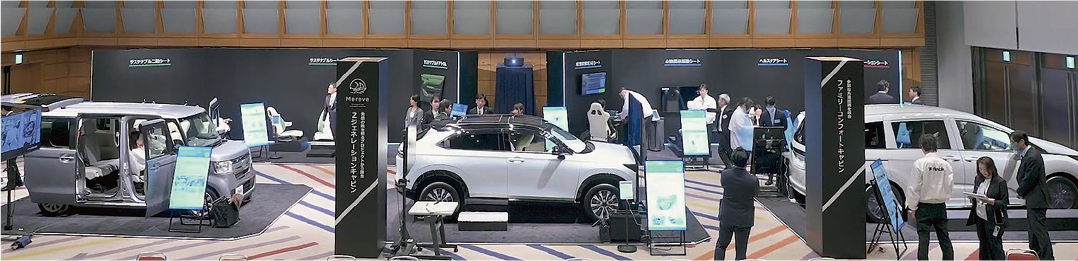
Overview of Next-Generation Automotive Cabin Exhibition 2024
The Next-Generation Automotive Cabin Exhibition is an event designed to enhance TS TECH’s corporate value by presenting new concepts for vehicle interior spaces to stakeholders, incorporating a wide range of innovative technologies.
Held for the second time in November 2024—two years after its inaugural event in 2022—the exhibition responded to customer feedback requesting to see how interior components operate within actual vehicles. To meet this request, we showcased three cutaway models that embodied our vision for unprecedented cabin environments inside real vehicles. These were presented alongside eight other next-generation products designed to meet the diverse needs of today’s mobility landscape, for a total of 11 exhibits.
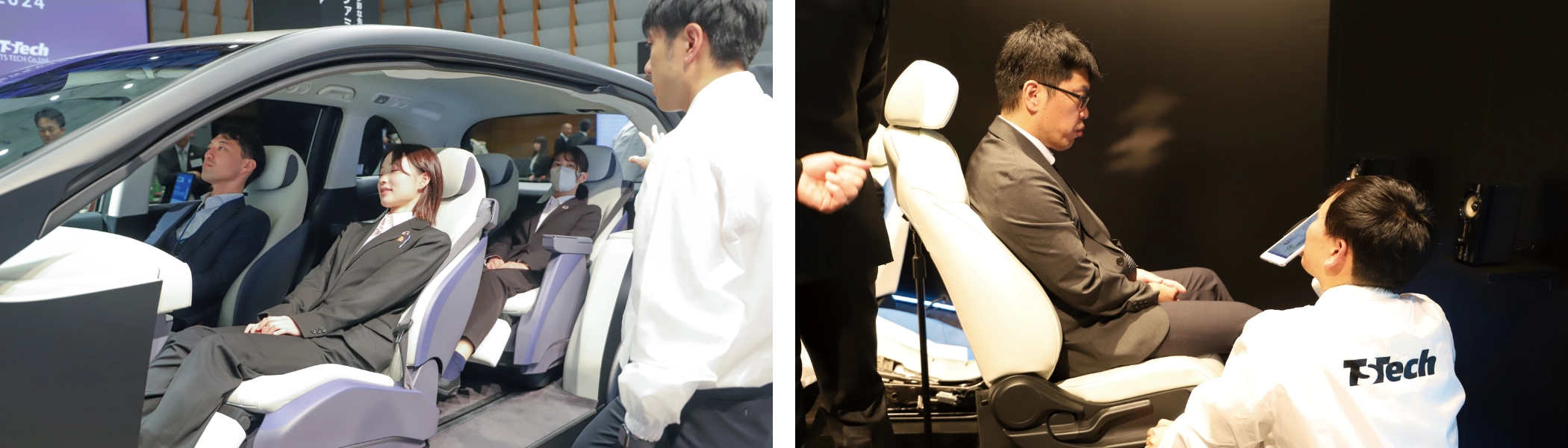
Prior to the main exhibition, we held a pre-event for automakers, which was attended by 11 companies, including Honda Motor Co., Ltd. The event proved to be a valuable platform for future business expansion. Visitors who experienced our latest technologies provided favorable feedback, with comments such as, “We got a real sense of how the seating domain business has expanded to encompass a wider area,” and “It was refreshing to see new proposals that addressed the entire cabin space, not just seating.”
| Exhibited products | Values delivered |
|---|---|
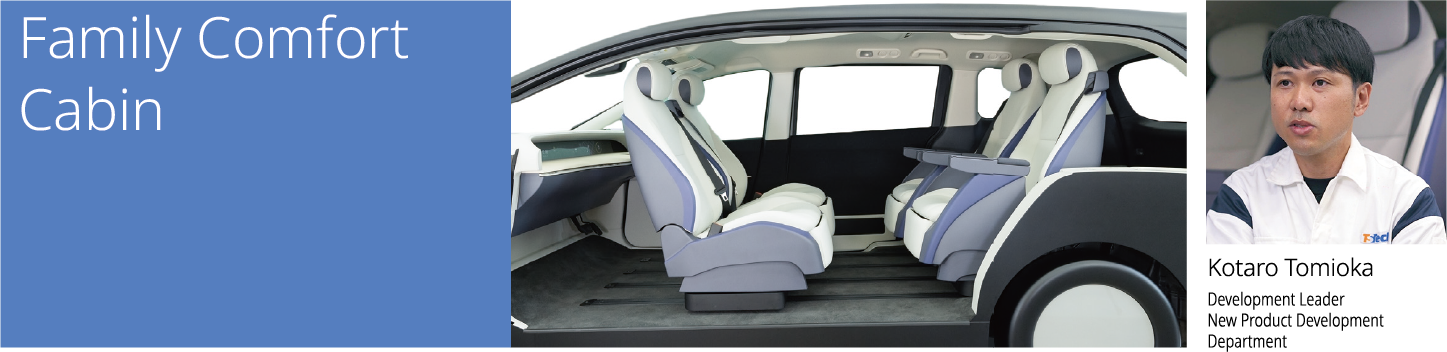
| Family Comfort Cabin | By offering a wide variety of seat arrangements, this interior creates mobility experiences that help family members develop deeper bonds with each other. |
| Generation Z Cabin | With a design that allows opportunities both for “sharing with others” and for “personal time,” this cabin is compatible with a wide range of lifestyles. |
| Child Fun Cabin | Offering seat arrangements that suit the needs of parenting, this interior allows families with young children to travel in comfort and peace of mind. |
| Health Care Seat | This seat provides a health-conscious and comfortable seating experience, thanks to a function which helps improve posture, plus the femtech function. |
| Heart Rate Display and Vibration Seat | This seat provides vibration stimulation in response to the heart rate of the passenger, to support safer driving and improve the entertainment experience. |
| Fatigue Level Estimation AI Seat | This seat can boost the performance of e-sports athletes by visualizing fatigue levels. |
| Sustainable Seat and Door Trim | By reducing the number of different components and materials and making use of plant-derived materials, we contribute to reducing CO₂ emissions and improving recyclability. |
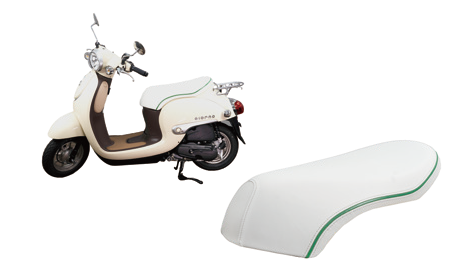
| Sustainable Motorcycle Seat | We are delivering a reduced environmental footprint while ensuring user comfort by using plant-derived urethane and post-industrial materials. |
| Next-Generation Architecture ECU※2 | Next-Generation Architecture ECU uses scalable control technologies to ensure flexible compatibility with the evolution of vehicle functions in the age of the SDV.※3 |
| Seat with High-Efficiency Ventilation | This seat delivers reduced energy consumption and costs while maintaining comfort, through the use of flow channel design to minimize energy loss. |
| Tough and Functional Off-Road Buggy Seat | This seat ensures a comfortable seated posture even when driving a buggy through harsh environments, delivering both functionality and durability. |
- Post-industrial materials: Materials generated during the manufacturing process before products reach the market.
- ECU: Electronic Control Unit. A unit which controls a system via electronic circuits.
- SDV: Software Defined Vehicle. A vehicle whose functions and performance are defined and controlled by software.
Technology that evolves to serve humans: new cabins envisioned by TS TECH
Designing a space that will turn a family’s travel time into their “enjoyable moments”
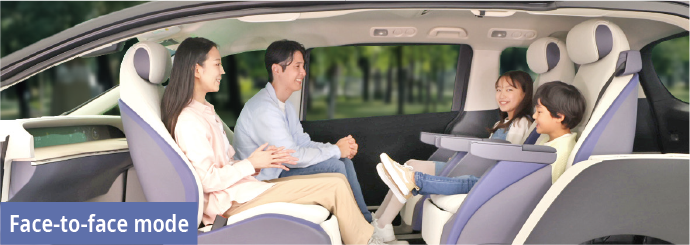
We have incorporated some innovative seat arrangement functions into the limited space of a cabin, with the aim of creating a minivan space where the whole family can spend time in comfort. To the long slide seat rail, which moves backwards and forwards, we have also now added a horizontal slide function, allowing the space to be used in various ways depending on the situation. The face-toface mode, which rotates the front seats automatically, was a particularly difficult challenge for a minivan of this size with a center pillar construction. However, thanks to our technical expertise and the creative ingenuity of our team members, we have succeeded in creating new opportunities for family interaction. It was the requests we were hearing from people currently raising children that prompted us to develop this design. This development initiative was inspired by feedback from families with young children, who voiced concerns about boredom during traffic jams, overcrowded service areas, and fatigue from long journeys. Our goal was to address these everyday challenges through technology.
In designing the cabin, we went beyond a “children-first” approach to create a comfortable space for adults as well—an environment that serves as a relaxing “living space” for the entire family.
A space that creates new experiences and values
Among our diverse seat arrangement options, the “zigzag mode” features a staggered seat layout that enables clear lines of sight between parent and child, fostering a sense of security and encouraging communication. Seats are equipped with built-in speakers and vibration devices that synchronize with audio and video content to deliver immersive entertainment experiences.
Additionally, the seats include game control functions that connect to smartphones, allowing children to engage in physically interactive gameplay using the seat as a controller. For adults, the Health Care Seat developed by TS TECH supports comfortable activity after long journeys by incorporating a sensing function and air cell device that help reduce fatigue and improve posture. It also features a femtech mode that gently warms the pelvic area to relieve tension and ease menstrual discomfort, addressing the specific needs of female passengers.

Creating new value through technical innovation and internal collaboration
To realize the face-to-face seating mode, we focused on designing a layout optimized for vehicle packaging in models with the commonly used center-pillar structure, while also taking manufacturing costs and mass-production feasibility into account. Flexible seat arrangements within limited cabin space were made possible through coordinated control using long slide seat rails, combined with integrated control for all these functions via our proprietary electronic control unit (ECU). Despite encountering technical issues just before the exhibition, our team members took initiative and successfully brought our envisioned cabin space to life.
Driving innovation in mobility experiences
The product we have developed is not merely a concept for display— it marks a meaningful step toward realizing the future potential of minivans.
We will continue refining each technology with the aim of integrating them into production vehicles, while proposing cabin experiences that offer greater freedom and richness for all passengers. As cabin possibilities continue to expand alongside technological evolution, we see the Family Comfort Cabin as a milestone—not a destination—on our journey to creating a future where both children and adults can truly enjoy the experience of mobility. We will continue listening to user feedback as we move forward.
Designing a cabin that empowers young people to express their individuality
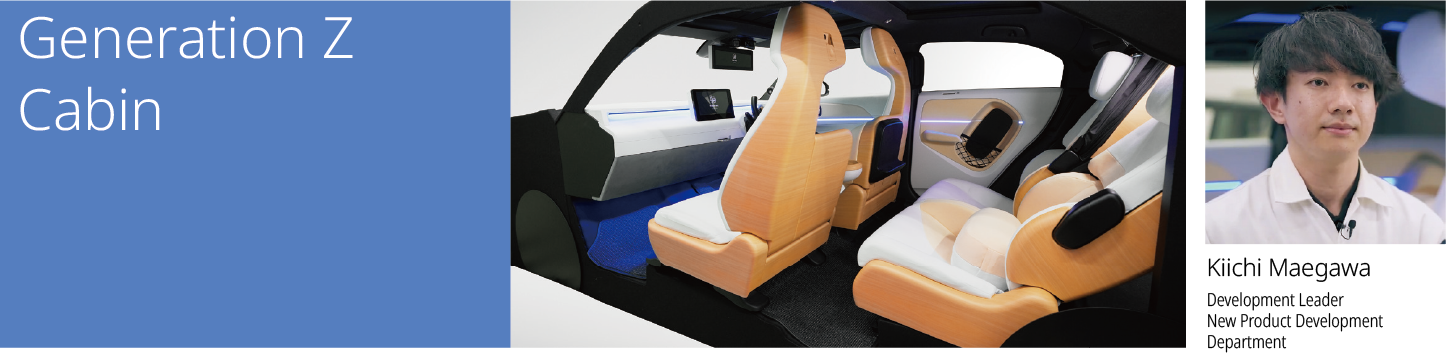
We developed the Generation Z Cabin with the aim of creating mobility environments that empower young people to express their individuality, in alignment with the values of Generation Z. This cabin features a design that sparks excitement even before boarding, along with emotionally responsive features that reflect the unique preferences of younger users—distinguishing it from conventional vehicle interiors.
Generation Z, born between the late 1990s and around 2010, includes individuals who experienced the COVID-19 pandemic during their student years. Having grown up with limited opportunities for face-to-face interaction, they place importance on balancing public and private identities. We believe that understanding and embracing these values is key to designing spaces that appeal to this generation.
Spaces that deliver new experience value
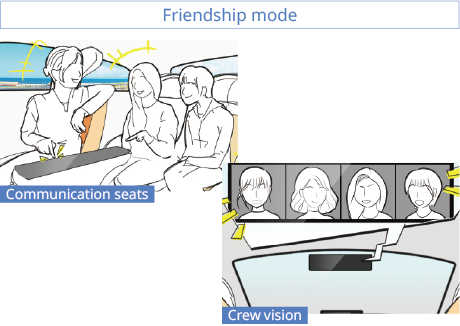
The Generation Z Cabin features two modes. The first is “friendship mode,” which focuses on shared enjoyment during travel. This mode features a seat layout that minimizes barriers between front and rear seats, enabling natural face-to-face communication. A central table-shaped display presents suggestions from an AI character—such as destinations and music—encouraging group interaction among passengers. Additionally, the rearview mirror is designed to reflect the facial expressions of rear-seat passengers, supporting active communication during travel.
The second mode, “womb mode,” is intended to provide personal time. In this mode, passengers can adopt a fetal position for relaxation, using a “hugging cushion” stored in the door. The cushion expands rhythmically to simulate breathing and deliver warmth. The seat, equipped with air cells, gradually transforms to embrace the passenger from behind, while a canopy emerges from overhead to create a private, secure space. When the air cells are activated, a calming scent is released, and an AI character appears on the monitor inside the canopy to offer calming messages. This design surrounds the user with warmth and scent, creating a deeply reassuring environment.

Young employees driving value creation: Challenges and future outlook
I was appointed as a development leader in my third year at TS TECH, and although I initially felt uncertain about whether our ideas could truly be realized, my peers and I continued to refine and test our concepts through trial and error. At the exhibition, we received positive recognition from multiple automakers for the successful realization of our concepts, which made us realize that delivering tangible value is key for conveying our vision to customers. I believe this outcome reflects TS TECH’s corporate culture of empowering young employees to take on challenges. Looking ahead, we will continue to advance our technologies toward commercialization, while incorporating feedback from the younger generation to further evolve the mobility experience. Through expanding the possibilities of vehicle interiors, we aim to create future mobility spaces that enable authentic self-expression for all users.
Innovations perfectly adapted to user lifestyles and environments
Fatigue Level Estimation AI Seat
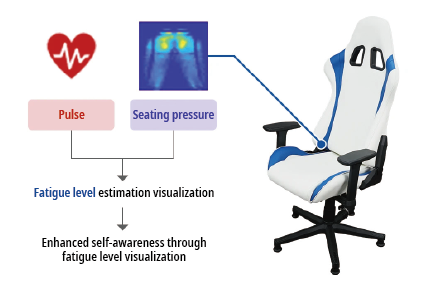
In 2023, we entered into a business partnership with KICONIA WORKS, Inc. to jointly develop a fatigue level estimation algorithm using seating pressure data from seat sensors and heart rate data from smartwatches. By conducting proof-of-concept testing aimed at applying the system to e-sports, we confirmed that visualizing fatigue levels helped improve player performance. Looking ahead, we aim to apply this technology to vehicles to support safer driving.
Vibration Seat with Heart Rate Display
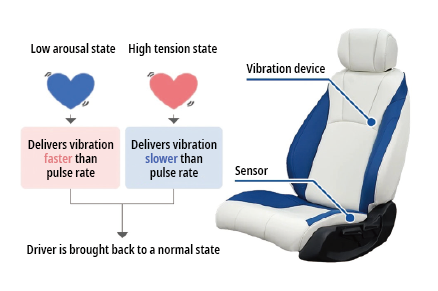
This seat senses the passenger’s heart rate using sensors embedded in the seat and a smartwatch worn on the wrist, and delivers vibration stimuli synchronized with the detected pulse rate to help stabilize emotional state and support safer driving.
The seat also supports entertainment applications—for example, by delivering vibration stimuli faster than the passenger’s heart rate during dramatic scenes in in-vehicle video content, enhancing the sense of tension and immersion.
Sustainable Seat and Door Trim
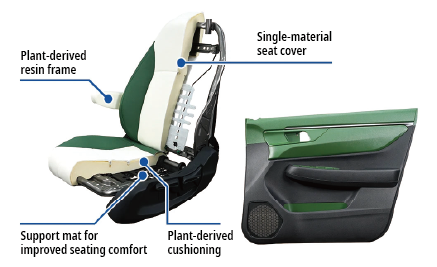
Traditionally, seat covers have been manufactured using a wide variety of materials, which complicates recycling. By reducing the number of components and materials used, we have created a simplified material structure that facilitates easier recycling after disassembly. We also optimized the seat structural to ensure comfort even when using plant-based materials. For door trim, we adopted single-material decorative components, enabling recycling without separation process. Finally, our shift from petroleum-derived to plant-derived materials is also contributing to a reduction in product-related CO₂ emissions.
Sustainable Motorcycle Seat
We are contributing to the reduction of product-related CO₂ emissions by increasing the use of plant-derived urethane in seat cushions, partially replacing the traditionally used petroleum-based materials. Despite this shift, we have maintained the same level of seating comfort as previous levels. In addition, the resin frames used in seat structures incorporate not only virgin materials but also scrap resin generated during manufacturing processes at TS TECH and other companies, further enhancing sustainability initiatives.